Where Leads Actually Go to Die (and How to Automate the Fix)
Ask most business owners where they lose leads and they'll point to the top of the funnel: not enough traffic, not enough calls, not enough people finding them. That's a real problem, and it's worth solving. But it's rarely the biggest leak.
The bigger leak happens after someone has already raised their hand. They filled out a form, or asked a question in chat, or left a voicemail, and then... nothing happened fast enough, or consistently enough, and they quietly moved on. That lead didn't fail to appear. It appeared, and then it disappeared, because nobody, and nothing, followed up in time.
The gap between "interested" and "customer"
A lead that just came in is warm. It stays warm for a surprisingly short window. Every hour that passes without a response, the odds of that person becoming a customer drop, not because they stopped needing what you offer, but because they moved on to whoever responded first. Most businesses lose leads here, quietly, one at a time, in a way that never shows up as a single dramatic failure. It just shows up as revenue that never quite arrives.
What the full automation chain actually looks like
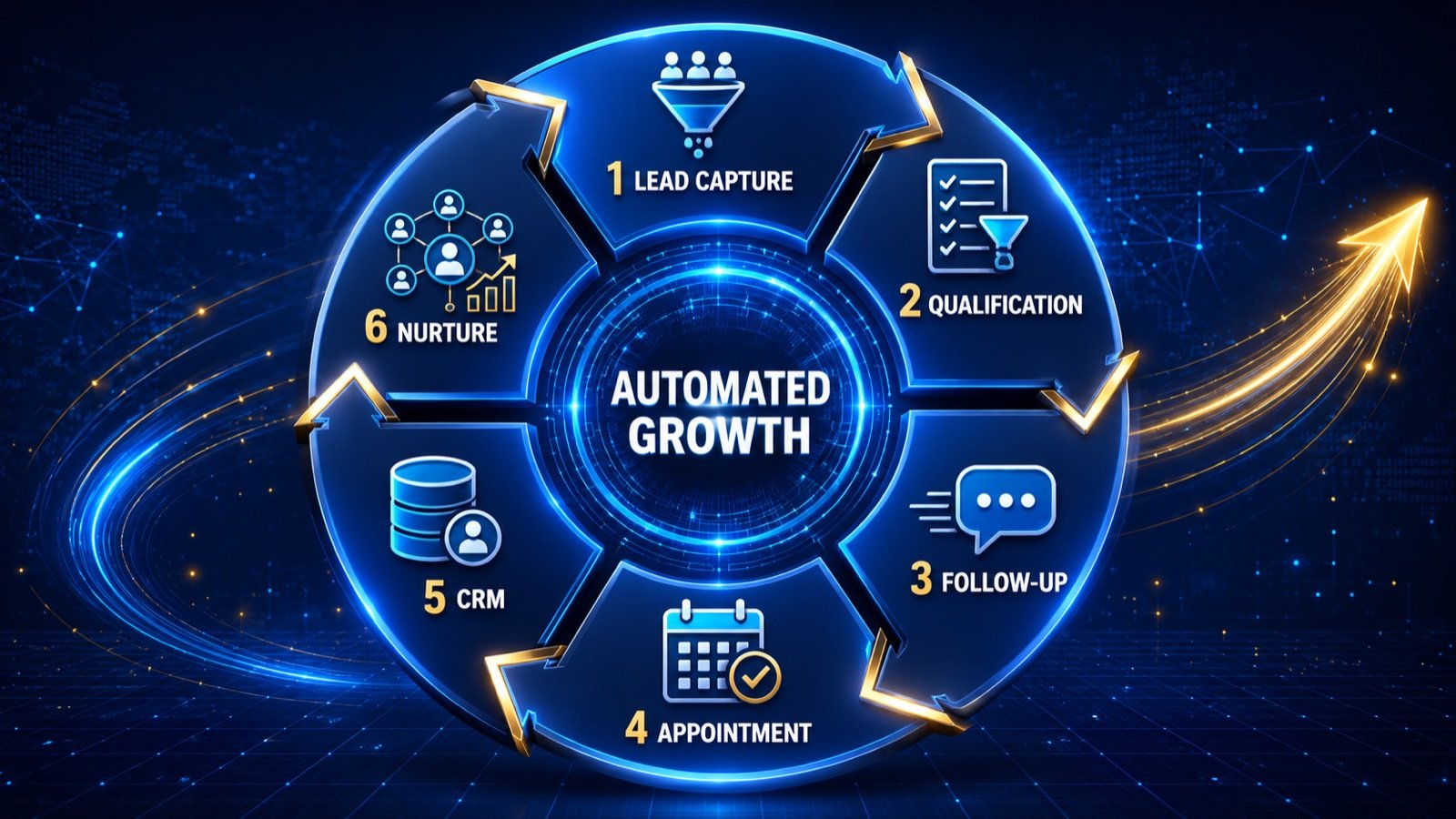
This is the whole point of building automation as a system instead of a single tool. Each step hands off cleanly to the next:
- Capture. The moment someone reaches out, by form, chat, or call, that interest gets recorded immediately, not whenever someone checks their inbox.
- Qualification. A quick, automated read on what they actually need and how urgent it is, so your team's time goes to the leads worth it.
- Follow-up. Automatic, immediate, and consistent, whether that's an instant text, an email, or a call. The speed here is what actually saves the lead.
- Appointment. Booked directly, without the back-and-forth that lets a lead go cold while you're both trying to find a time that works.
- CRM. Everything logged automatically, so nothing depends on someone remembering to write it down.
- Nurture. For the leads that aren't ready yet, a real sequence that keeps the door open instead of letting them vanish into a list nobody looks at again.
Why this has to be automated, not just organized
A great follow-up process that depends on a person remembering to do it, every time, for every lead, at every hour, eventually breaks. Not because anyone's bad at their job. Because people get busy, get sick, take weekends off, and have exactly one thing happening at a time. Automation doesn't get busy. It follows up the same way at 2pm on a Tuesday and 9pm on a Saturday, which is exactly when a lot of real interest actually shows up.
What to check in your own process right now
- How fast does a new lead get a first response? If the honest answer is "depends," that's the gap.
- What happens to a lead that isn't ready to buy today? If it's a spreadsheet nobody revisits, that's revenue sitting on the table.
- Is everything actually landing in one place? Leads scattered across a form inbox, a phone log, and a few sticky notes are leads that are easy to lose track of.
- Does booking an appointment take one step or five? Every extra step is another chance for someone to not finish.
None of this is about replacing your team. It's about making sure every single lead gets the same fast, consistent response, the one a great salesperson would give if they were available every hour of every day. That consistency is what actually turns interest into revenue.
Want to see where your own leads are actually falling through?
We'll map your current process and show you exactly where the gaps are.
Build My AI Growth Engine